
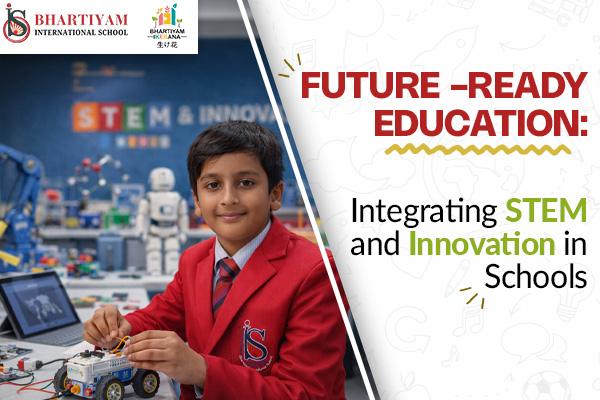
In the present education sector, students worldwide are being prepared to adapt to a rapidly changing, technology-driven future. The traditional methods driven by rote learning are no longer sufficient for children as schools are now expected to cultivate adaptability, creativity, and problem-solving skills, hence they offer future ready education. The changes in the curriculum and teaching methods that schools see in today’s time also lead to the growing adoption of STEM education and the rising focus on skill development and innovation.
What is the STEM Curriculum in Schools?
Firstly, STEM stands for Science, Technology, Engineering, and Mathematics. Its curriculum is a connection of all four subjects to make a cohesive study model that focuses on applying theoretical knowledge to practical problems and solving them. Such a curriculum is designed and adopted to provide STEM education in schools and prepare children for their future studies through inquiry-based learning, experimentation, and practical activities. The following are the key characteristics of the STEM curriculum:
- Interdisciplinary Learning: Concepts of different subjects are taught to solve practical problems
- Project-Based Approach: Students work on practical projects rather than memorization
- Inquiry and Exploration: Encourages questioning and experimentation
- Technology Integration: Use of tools like coding platforms, robotics, and simulations
- Real-World Relevance: Lessons are connected to everyday applications and future careers
What are the Components of STEM Lab?
A STEM lab, based at a school and being used in accordance with the STEM curriculum in schools, is a dedicated learning space designed to expose students to practical experimentation, innovation, and collaborative learning. The following are some essential components of a STEM lab that drive its benefits and importance at schools for students:
- Robotics Kits: They teach coding and automation to students
- Electronics & Sensors: Basic circuits, IoT kits, and microcontrollers (e.g., Arduino)
- Computing Devices: Computers or tablets are available with coding and simulation softwares installed
- DIY Experiment Kits: Includes physics, chemistry, and engineering experiment setups
What are the Benefits of STEM Education for Students?
There are several benefits of STEM education for students, which drive its demand among schools as well as parents, who are finding the best school for their children. Not only does it enhance the theoretical learning of students, but it also helps in building their analytical thinking, creativity, and technology literacy. The following are the various benefits explaining the importance of STEM education.
1. Growth of Critical Thinking
Critical thinking involves analyzing information, questioning assumptions, and making informed decisions. The activities a child gets to be a part of in STEM education encourage this critical thinking through experimentation and hypothesis testing. Students learn to:
- Evaluate evidence rather than accept information blindly
- Identify patterns and relationships in data
- Make logical conclusions based on observations
2. Better Problem-Solving Ability
Problem-solving is central to STEM education. During the many activities at a STEM lab, students are presented with open-ended challenges which they have to find answers to. Such an approach helps students:
- Break down complex problems into manageable steps
- Test multiple solutions and iterate
- Develop resilience when solutions fail
3. Enhanced Creativity
Creativity or innovation occurs at the intersection of logic and imagination. STEM education is that intersection where students are encouraged to:
- Design unique solutions to real-world challenges
- Combine artistic thinking with engineering concepts
- Explore multiple ways to approach a problem
4. Rise in Engagement and Motivation
As per reports, students get disconnected with their learning at school very often due to the teachers following a traditional lecture-based teaching method instead of making things interesting for children. STEM activities are practical and interactive, hence resulting in a growth in student interest and participation. This happens because:
- Learning becomes active rather than passive
- Students see real-world applications of concepts
- Collaborative projects make learning social and engaging
5. Better Foundation of Subjects
Integrating STEM in schools will help your students understand the core concepts of all subjects better than just textbook learning, as they would be exposed to the real-life use of those concepts. With such an approach, students gain:
- Deeper conceptual clarity in math and science
- Improved retention through practical application
- Ability to connect theory with real-world use cases
6. Skill Development
STEM based learning in schools goes beyond regular academics and helps in the development of necessary life and career skills that would be beneficial for students in the decades to come. These skills include:
- Collaboration and teamwork
- Communication and presentation
- Digital literacy and technological proficiency
- Adaptability and a continuous learning mindset
How is Innovation Developed in Students?
Innovation is one of the most essential qualities every student must develop at an early age, as this quality is what helps them further in problem-solving, creativity, and experimentation. Additionally, innovation is best developed in students when they get to face simulated problems and find their solutions themselves, which is a measure taken by modern schools in today’s time. The following are some key ways schools foster innovation:
- Project-Based Learning (PBL): Students work on real-world challenges over extended periods
- Design Thinking Approach: Encourages ideation, prototyping, and testing of projects
- Interdisciplinary Projects: Involves applications of theoretical concepts to solve complex problems
- Exposure to Technology: Availability of tools like AI, robotics, and coding platforms gives experimentation opportunities
Conclusion
Future-ready education does not mean just exposing students to new subjects but also training them to learn, think, and apply knowledge with the practicals of those subjects. Integrating STEM curriculum and innovation into schools creates a balanced learning environment that prepares students for academic success as well as real-world problems.
Enroll your child at Bhartiyam International School, the best CBSE school in Rudrapur, and witness them shine in academics with skill development due to our focus on STEM education, driving excellence among children.
FAQs
Q. What is the main purpose of STEM education?
STEM education focuses on the skill development of students along with the enhancement of their theoretical concepts and is adopted to make the overall process of learning interesting for all children.
Q. Is STEM good for kids?
Yes, STEM is good for kids of all ages or grades at a school, as it supports their personal development and academic learning with engagement.
Q. What is a STEM lab in schools?
A STEM lab in schools is a space where students engage in practical activities revolving around different subjects and concepts, enhancing their skills and theoretical learning with the help of different types of equipment.